N2EC Amateur Radio

Ed’s Adventures in Amateur Radio

Author: Ed N2EC

  • POTA Activation #2 – George Washington Memorial Parkway (VA) (2/27/2022)

    POTA Activation #2 – George Washington Memorial Parkway (VA) (2/27/2022)

    For my second activation I decided to try something closer to home and went to Riverside Park in the George Washington Memorial Parkway (K-0670VA). I was a bit ambitious in my plans, as I was determined to try using a new antenna that I had not setup before, the Buddipole Buddistick Pro. The antenna is an engineering marvel, but is a bit more challenging to get going. I was able to get it assembled quickly, but was having a hard time getting it to tune to the right SWR where I wanted to operate. After about a half hour, I decided to bring out my MFJ 1984 MP end-fed half wave antenna, and was able to get quickly on the air.

    In hindsight, I now know what the problem was: the Buddistick Pro requires an elevated radial (provided). I was using a hiking pole for this task, but it was aluminum. I think that there was some capacitive coupling going on there that was making a good match all but impossible. I was able to fix it later after acquiring a $3 electric fence post, but more on that another day.

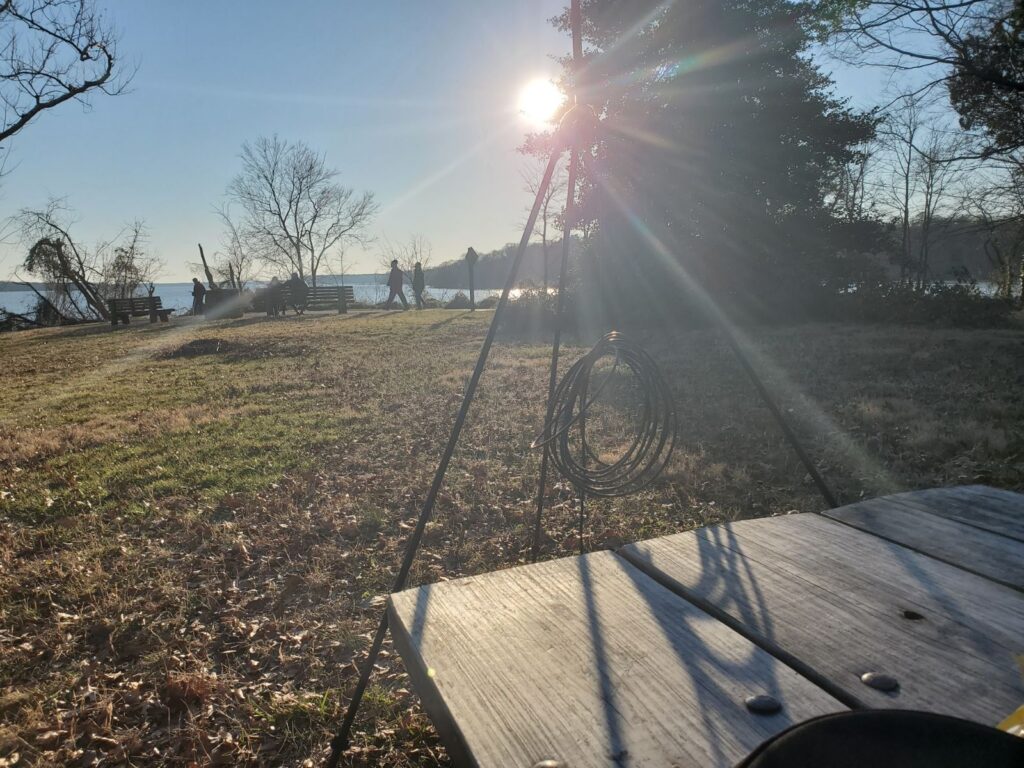
    After getting the EFHW into the trees I was off and running. Below is a picture of part of the Buddistick Pro which would share in the adventures of the next activation. In the background you can see how beautiful the park is. It is nestled between the George Washington Parkway and the Mount Vernon Trail alongside the Potomac River. On the other side of the bench in the distance is the pier at George Washington’s Mount Vernon. Everywhere you turn there are heritage trees and gorgeous views. Right at the crest of a small hill sit a few picnic tables under the shade of those trees, and that’s where I set up.
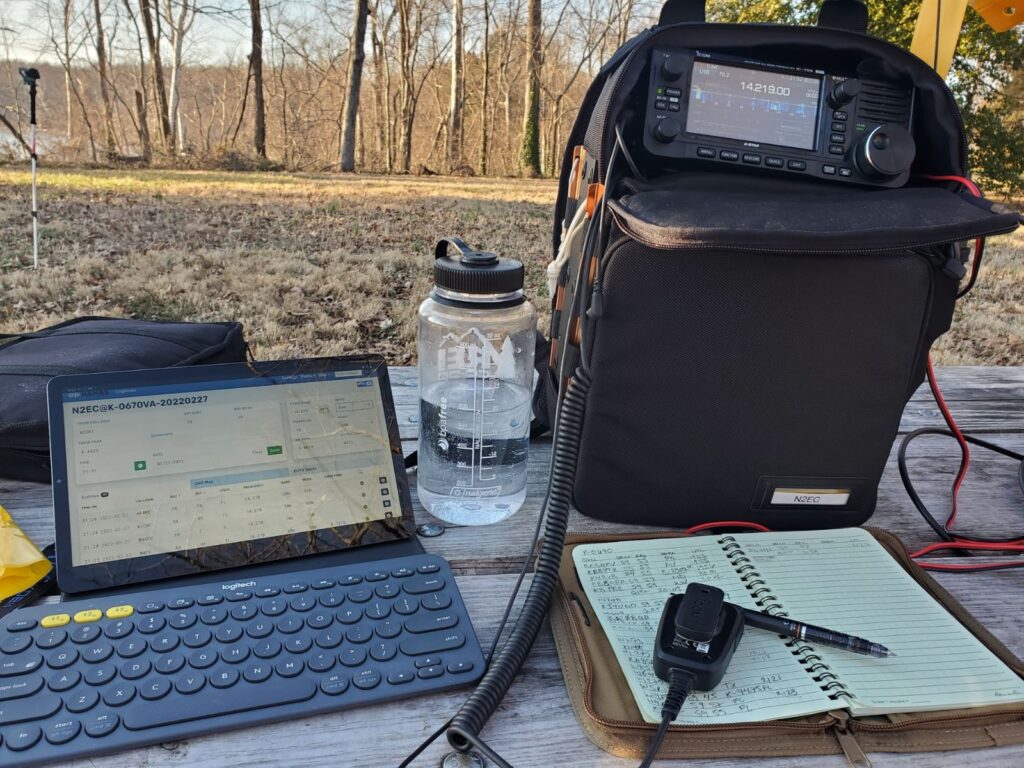
    This activation had another first — I used HAMRS for logging alongside my paper log. This made the submissions much easier, and paired with a bluetooth keyboard I was able to quickly get things into the log. Thankfully, I didn’t forget any equipment this time, and I was able to set up a very comfortable operating position with a gorgeous view. I still default to paper logs (they tend not to crash — although HAMRS has not failed me thus far), but I try to get things in the logs straightaway. If I have internet access on my phone I can even send off my logs to Parks on the Air before I even leave the park.
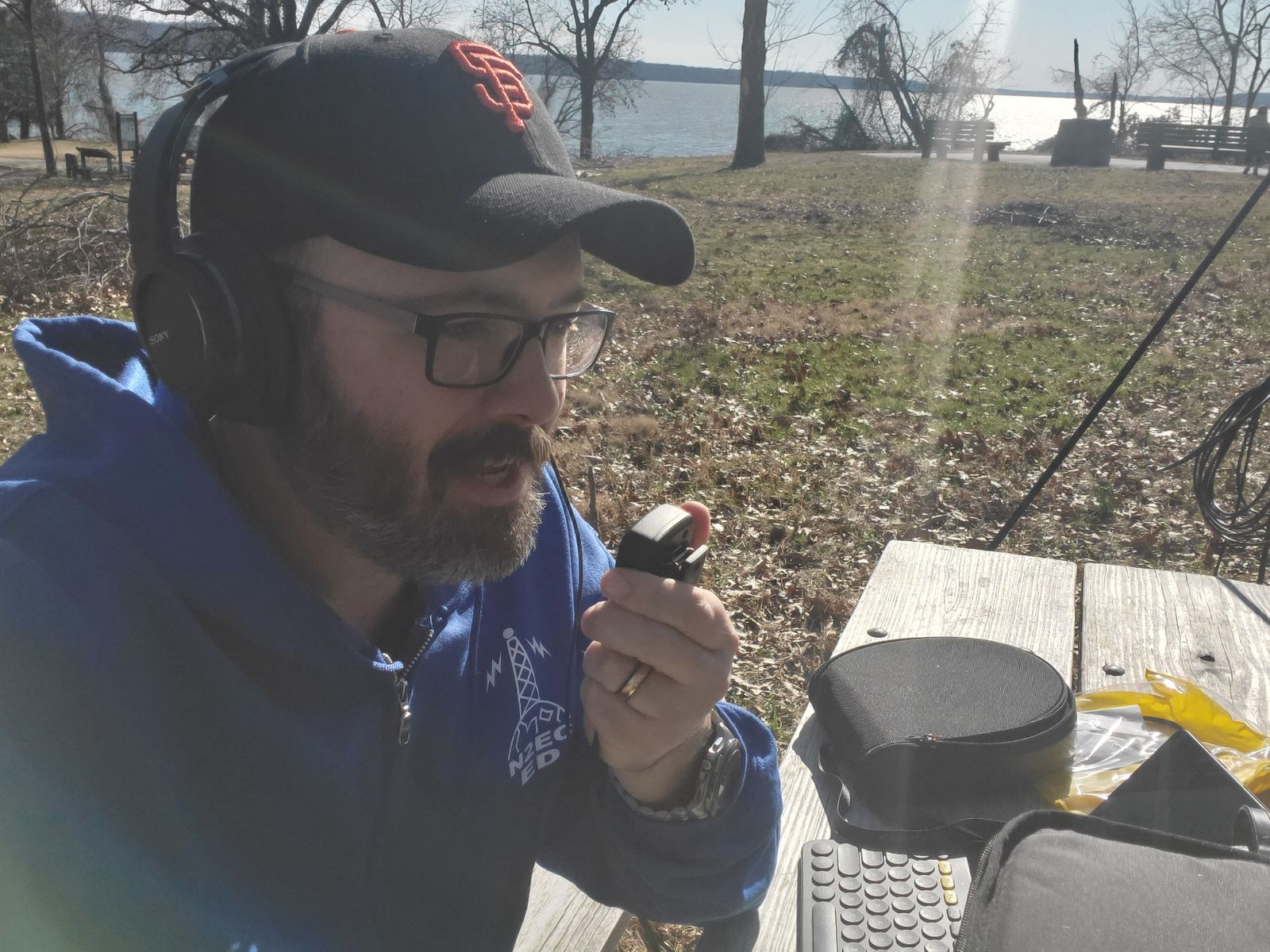
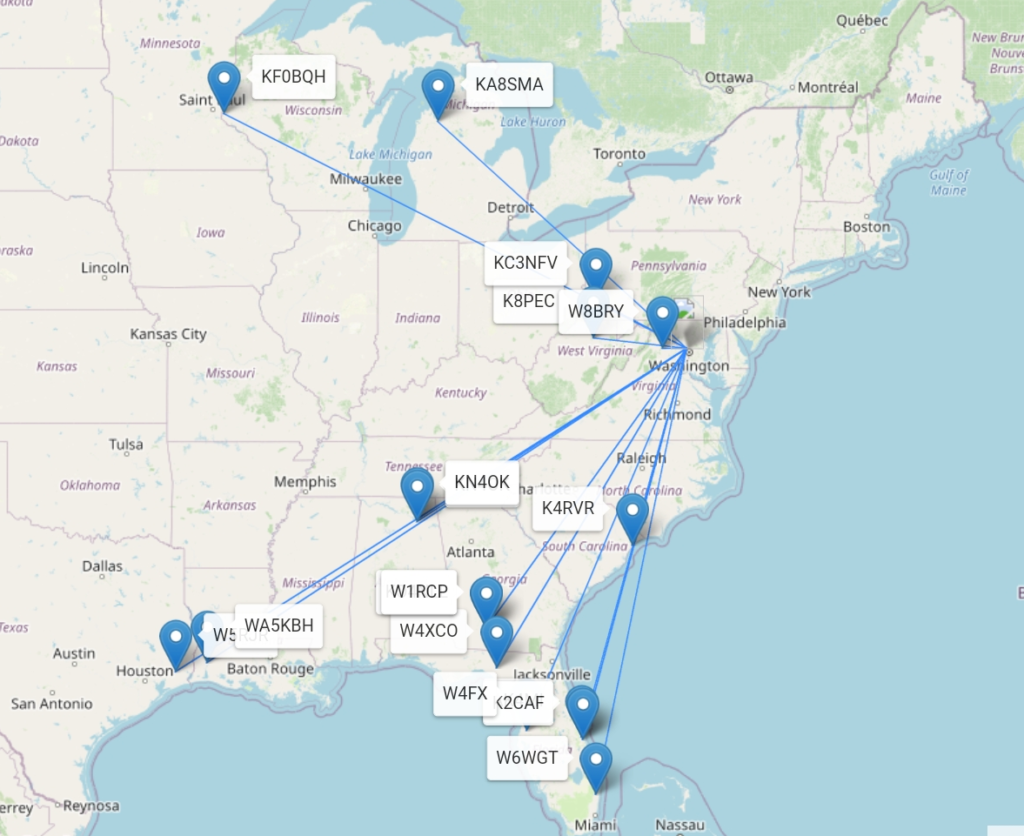
    Learning from my last activation, I decided to get things started on 40m and set up on 7.290 MHz and gave myself a spot. Right away people found me, and the first call was N4D, a 1×1 special event station for the NC QSO Party. From there the calls kept coming from NC, SC, MD, PA, VA NY, KY, Ontario Canada, MI, and WV. After things slowed down a bit, I decided to go for redemption on 20m and made several more contacts with operators in AL, WI, GA, MI, LA, and FL. I also picked-up 6 Park to Park contacts, for a grand total of 43 contacts in 2:01 on the air. Amazing what 10W and a bit of wire can do.
    I heard a station operating out of DC, but unfortunately, he could not hear me. That missed contact inspired the next activation to come. More on that soon.

    This was a great activation, even if it started out a bit rocky with the antenna issues — and spoiler alert: those get resolved in our next episode.

    Gear used in this activation

    • Icom IC-705
    • MFJ 1984 MP
    • LDG Z100 Plus
    • RigExpert Stick Pro Antenna Analyzer
    • Icom LC-192
    • Jackery Explorer 500
    • Sony Headphones
    • Samsung Galaxy S6 Lite Tablet
    • Logitech K380 Bluetooth Keyboard
    • Rite in the Rain Notebook
    • Zebra DelGuard Mechanical Pencil

  • POTA Activation #1 – Mason Neck State Park (VA) (2/19/2022)

    POTA Activation #1 – Mason Neck State Park (VA) (2/19/2022)

    I have been an amateur radio operator since I was 10 years old, but over the years I had gotten a a bit distant from the hobby.  Not too long ago, I decided to change that and to get the station I had used with my Dad growing up back on the air.  I had to get a bunch of equipment set-up at my house (antennas, cables, grounding, cable feedthrough panels, etc). But once I got back on the air I remembered what had made the hobby so fun while I was growing up.  As I started making contacts I discovered  Parks on the Air.

    Parks on the Air is a radio game that encourages people “activate” state and national parks.  To “activate” a park, you need to set-up an amateur radio station inside a park and make at least 10 contacts.  The more contacts you make, the more you get achievements and awards in the game.  Good clean fun.

    To activate you need to go to a park, but the easier part is to “hunt” which you can do from anywhere.  All that’s involved is making a contact with someone in the park on the air.  They log the contact, and you get credit and awards on the Parks on the Air (POTA) site as soon as the logs they submit get posted.   The POTA web site is quite well done, and has lots of tools to help you make contacts.  The most useful tool is the “Spots” page, which shows you all the people activating parks at any given time, along with their frequency, mode of operation, park information, and other information from the person (or computer) that spotted them.

    Very quickly you can find people in the parks and work them — which is convenient, as many of the people activating the parks may be running QRP (low power), so they might be hard to find on your own.  Since so many people are playing and having a blast with the game, you’ll frequently get a “pile-up” where dozens of people rush to work an activator in the park.  It can be a lot of fun.

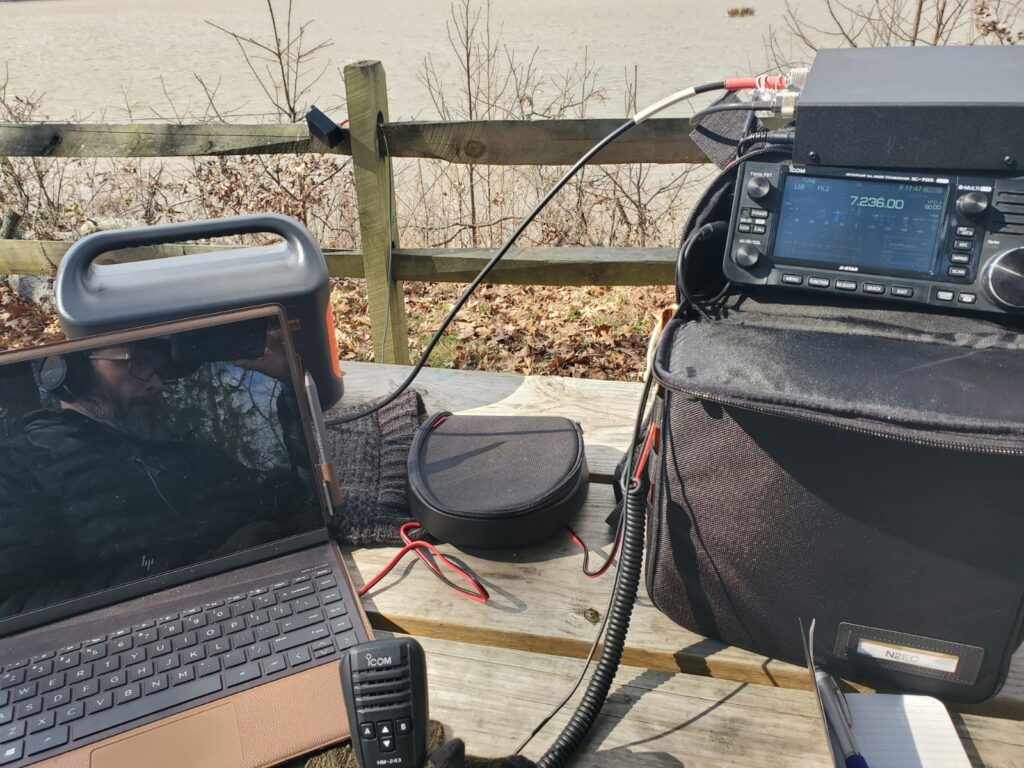
    After being a hunter for a while and looking forward to each opportunity I had to work a station that was activating out in the field, I wanted to try my hand at activating a park.  In order to do this, I would need a fair amount of new equipment.  I started researching what I’d want to get and settled on a QRP  (low power) radio that is so small it can be packed up inside a small backpack, along with everything you need to run it.  I selected the Icom IC-705 which is a very well regarded modern transceiver that has an excellent software defined radio.  I decided to pair it with an MFJ 1984 MP end-fed halfwave antenna that would be able to be easily tossed up into a tree with an arborist’s throw line.  To make sure that the radio and the antenna played nicely with each other, I also got a LDG Z100 Plus antenna tuner that runs off low battery power.  I already had a Jackery Explorer 500 to provide battery power (way more than was needed) and headphones to make sure I could hear everything well.   I used the Icom LC-192 backpack to carry all the radio stuff and decided to take it all out to Mason Neck State Park to give everything a try on February 19, 2022.

    Mason Neck State Park is a beautiful gem of a park out on Mason Neck in Northern Virginia by the Potomac river, South of Alexandria and across Belmont Bay from Woodbridge and the mouth of the Occoquan river.  There are a few miles of trails that go through a varied landscape ranging from beaches along the bay, marshland, and  forest.  I’ve hiked there many times, and have even gone out on my canoe to explore around Mason Neck and Belmont Bay.

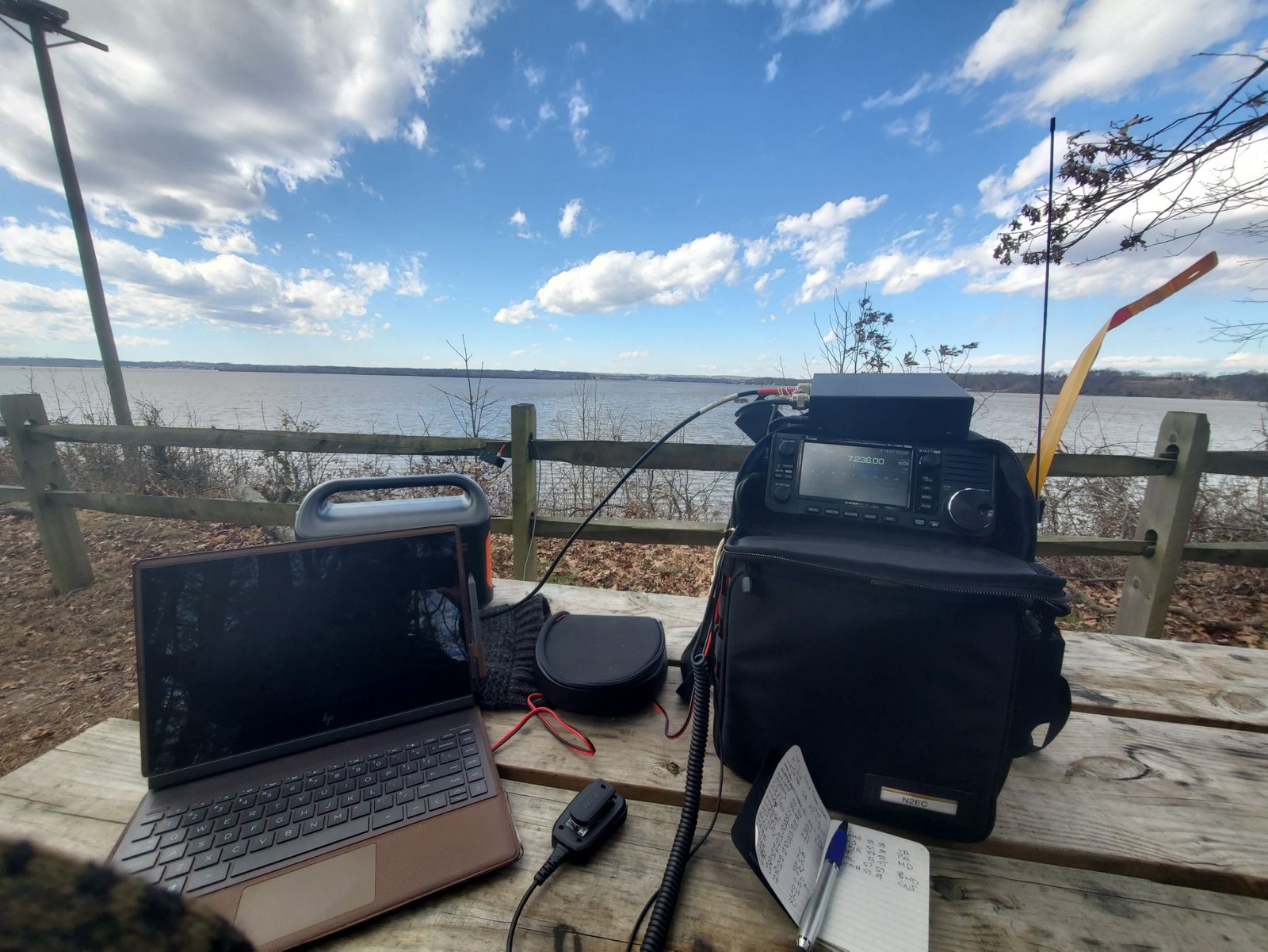
    February 19, 2022 was a rather windy and chilly day, but I was so excited to put my gear to the test that I bundled up and drove  down and decided to set up camp at a picnic table near the visitor center that overlooked Belmont Bay.  From my perch I saw bald eagles and numerous turkey vultures hovering in the strong winds just a few dozen feet in front of me.   They always say that the first time you do something, you’re bound to forget at least one thing. That adage was proven correct for me as I left my arborist throw-line kit at home.  I only noticed once I had already unpacked my car, and I decided to roll-with the punches and see what I could do with the equipment I had on hand.  Without the line, I could not get the antenna higher into the trees than I could reach.  Fortunately, the trees near where I had setup had low branches and I was able to tie the end of the antenna off to a fence post that ran along the cliff that borders the waterfront.

    After getting everything up and running I made my first contact on 20m on 14.314 MHz — success!  Unfortunately, it didn’t seem like I was being heard well on the band, and I had some stations start doing their own contacts over top of me.  I decided to switch bands and give 40m a try.  After searching for a spot I settled on 7.236 MHz, spotted myself on the POTA web site, and the pile-up began.  Station after station answered my call and made contact with me.  The action was exhilarating — this is what DX stations must feel like when they work their pile-ups.  In about an hour and a half I ended up working 36 stations from 13 states (SC, WI, PA, MD, VA, FL, NJ, MA, NC, GA, IN, OH, and LA).  After a while the contact rate slowed down and the winds picked up to a blustery 50 mph.  Having made 3.6x the number of contacts required for a valid activation, I happily called it a day, packed up my gear, and headed to the warmth of my car.  I had an absolute blast and I knew that this would definitely not be the last time I would activate a park for Parks on the Air.

    Gear used in this activation

    • Icom IC-705
    • MFJ 1984 MP
    • LDG Z100 Plus
    • RigExpert Stick Pro Antenna Analyzer
    • Icom LC-192
    • Jackery Explorer 500
    • Sony Headphones
    • Laptop
    • Rite in the Rain Notebook
    • Zebra DelGuard Mechanical Pencil